
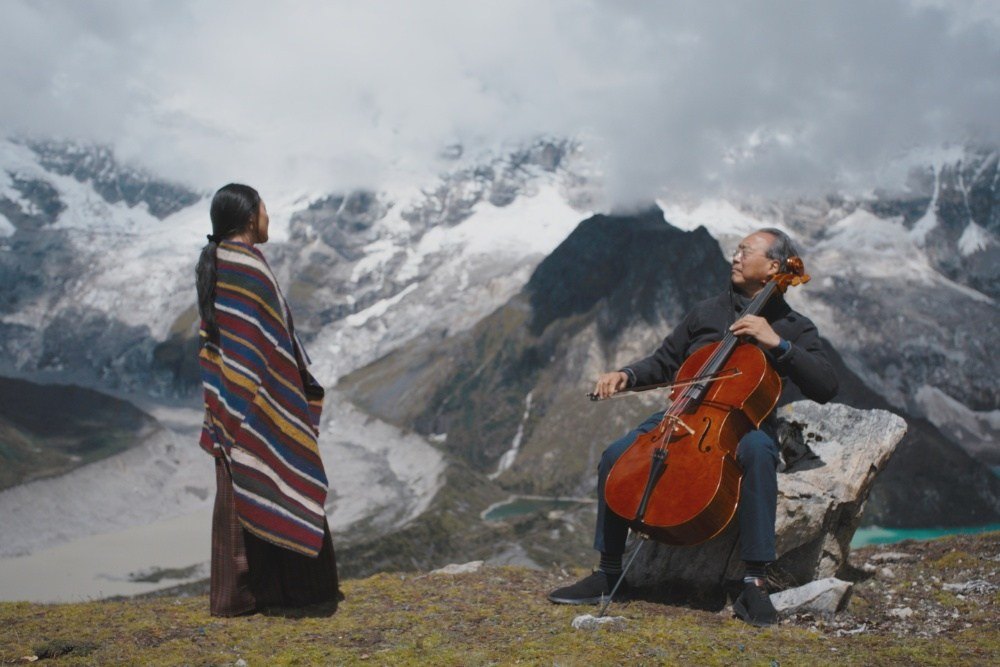
Yo-Yo Ma and Pawo Choyning Dorji unveiled the trailer for "A Song For The Snow Lion" ahead of its Telluride premiere. Dorji, whose films "Lunana: A Yak in the Classroom" and "The Monk and the Gun" have earned critical acclaim and Oscar nods, continues his exploration of Bhutan's cultural and environmental challenges with this new project. Ma, a renowned cellist who suffered altitude sickness during filming, performed alongside Bhutanese folk singer Kelden Lhamo at 18,000 feet elevation. The film uses the folktale of snow lions to symbolize purity and awakening in the face of melting glaciers.
Yo-Yo Ma and Dorji Unveil Snow Lion Trailer
Yo-Yo Ma and Pawo Choyning Dorji unveiled the trailer for "A Song for the Snow Lion" at the Telluride premiere. The film is produced by Sound Postings/Ode Studios/Dangphu Dingphu under 3 Pigs Production. Ma expressed his desire to visit Bhutan, meet its people, and see how they protect their glaciers, which feed major rivers in populous countries. "I have always wanted to go to Bhutan," he said.
Dorji highlighted the importance of storytelling over charts for environmental education: "A Bhutanese child does not learn to protect the mountain by being shown a chart." He also noted the urgency of addressing climate change: "Our glaciers are melting away regardless of what we choose." The film ties together the cultural significance of folktales with environmental issues, emphasizing their interconnectedness. Ma shared his experience filming at high altitudes: "It was a life-changing experience... performing with her at 18,000 feet, looking down at glacial lakes.
Exclusive Telluride Premiere Announced
Chinese hit ‘Dear You’ sets wide North America release via Well Go USA, clip unveiled (EXCLUSIVE). Dorji’s “Lunana: A Yak in the Classroom” earned Bhutan’s first Oscar nomination for best international feature film, and “The Monk and the Gun,” which was shortlisted but did not go on to a nomination. Meeting Pawo was serendipitous, Ma says.
“She learns it because she is told a snow lion lives up there.” For Dorji, the folktale carries a meaning that took him years to see. In Bhutan, the hardship of reaching a sacred place is part of what makes the offering an offering. “We had gone up there to make an offering to something we were told lives in the ice,” Dorji says.
The film ties together cultural significance with environmental issues, emphasizing their interconnectedness without relying on traditional educational methods. A Bhutanese child does not learn to protect the mountain by being shown a chart but through stories and experiences. The urgency of addressing climate change is highlighted: “Our glaciers are melting away regardless of what we choose.” Dorji’s work in film aims to educate through narrative, making complex issues accessible to a broader audience.
Glaciers as Symbols in Bhutan Folklore
Dorji’s folktale explores the symbolism deeply rooted in Bhutanese culture: glaciers as symbols of purity and action, and the snow lion as an awakened mind rising from them. This metaphor reflects Dorji's personal journey back to Bhutan’s Lunana Valley, where he learned that reaching a sacred place is not about comfort but about embracing hardship. “You do not receive the blessing of a mountain by arriving comfortably,” Dorji emphasizes. The film connects these cultural symbols with environmental issues, showing how protecting nature is tied to spiritual and cultural practices rather than just scientific facts or educational campaigns.
On set, this philosophy translated into practical challenges for the filmmakers. Shooting at high altitudes required resilience and respect for the environment. Ma shared his experience filming at 18,000 feet: “It was a life-changing experience... performing with her at 18,000 feet, looking down at glacial lakes.” The physical demands of capturing such locations underscore Dorji’s message that reaching these sacred places is an offering in itself. This approach to filmmaking goes beyond the technical aspects, embedding environmental and cultural awareness into every frame.
Implications for High-Altitude Shoots
Filming at high altitudes presents unique challenges that require careful planning and execution. Dorji’s approach to shooting "A Song for the Snow Lion" in Lunana Valley highlights the importance of respecting both the environment and the cultural significance of the location. The filmmakers faced physical demands such as altitude sickness, with Yo-Yo Ma experiencing this condition during filming at 18,000 feet. This demonstrates that high-altitude shoots demand not just technical expertise but also a deep understanding of the local culture and environmental conditions.
The logistics of shooting in remote areas like Lunana Valley are complex. Dorji’s decision to focus on a folktale rooted in Bhutanese culture underscores the importance of narrative relevance to the setting. This approach ensures that the film resonates with both locals and international audiences, bridging cultural gaps through storytelling. The practical challenges faced by Ma and his team also underscore the need for support systems, including medical assistance and local guides knowledgeable about the terrain and climate. These elements are crucial for which keeps the safety and success of high-altitude productions.